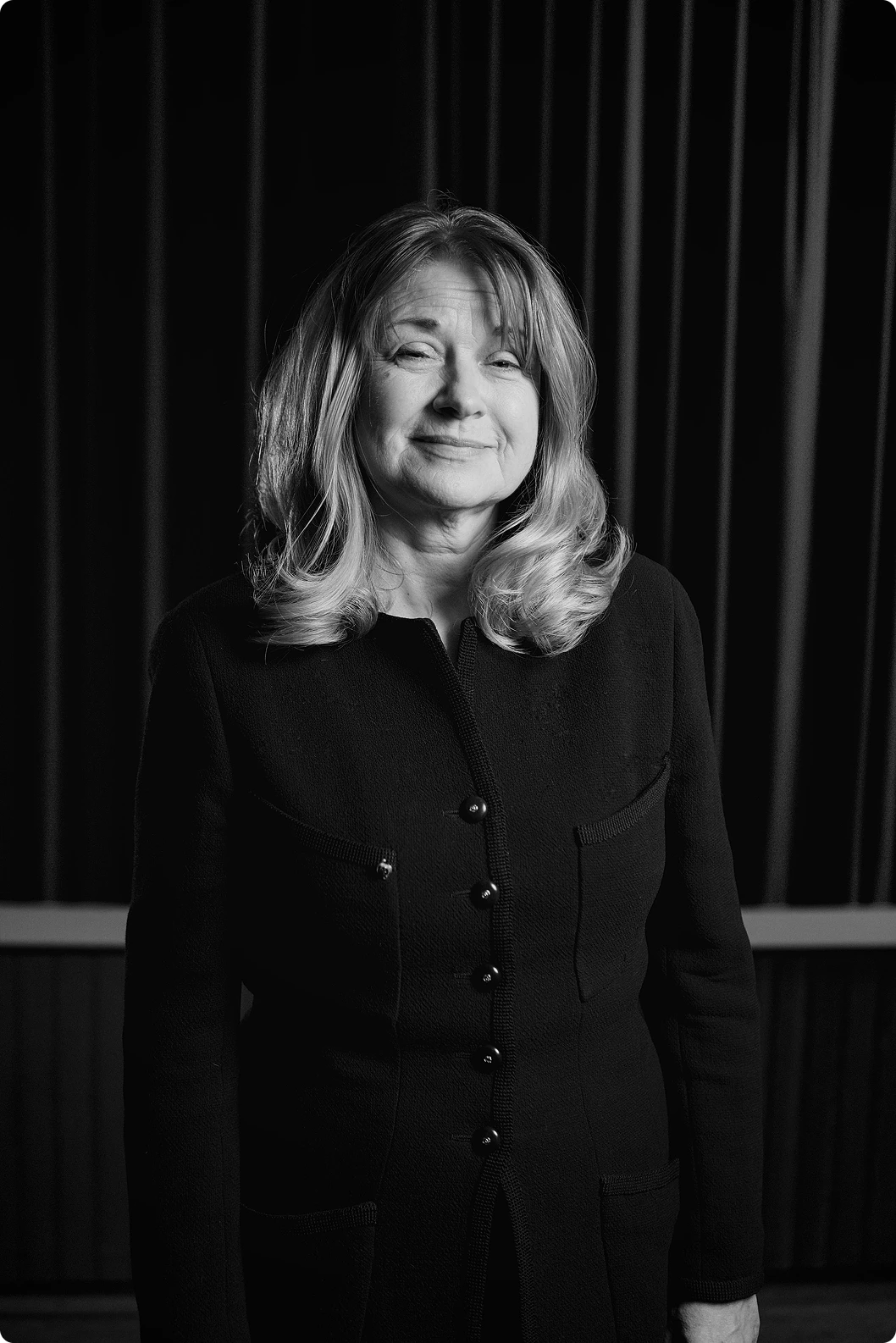
Barbara Karpetova
Barbara Karpetová is the Ambassador of the Czech Republic to Luxembourg, a position she has held since 2025. A career diplomat since 2006, she previously served in Washington, Moscow, NATO Headquarters in Brussels, and led the Czech Centre in New York. She holds a doctorate in social anthropology and focuses on diplomacy, culture, and European cooperation. In Luxembourg she actively promotes Czech-Luxembourg relations in culture, security, and innovation. She is also known as a strong and consistent supporter of Ukraine within Luxembourg’s diplomatic community.

I believe the only way to come close to understanding is through compassion. Reason alone can’t grasp it. I don't know about the others, but this is my path.
Am I just a tiny piece of a puzzle? Or could I be someone who helps put the puzzle together or even influence its shape?
I think it started quite early. I was four when our country was invaded by the so‑called Warsaw Pact armies. From that moment on, life in my family changed so much that—even as a child who didn’t really understand what was happening—you could sense it. You suddenly realize there are powers, eruptions, turbulences in this world that shape the life of an individual.
And at some point, when you begin to think for yourself, you ask: Am I just a tiny piece of a puzzle? Or could I be someone who helps put the puzzle together or even influence its shape? It’s a long process, of course, but eventually you have to decide whether you want to be part of a world that simply carries you along with the stream—because it will—or whether you want to look at that stream from above.
Later, when you study history—still under a regime shaped by Soviet doctrine—you’re told that the invasion was “help,” that we should be “thankful” for being “protected"
While growing up, did you feel that you were part of the people carrying the spirit of resistance of 1968?
That kind of conscious understanding comes much later—when you learn history and hear what really happened. As a child, I mostly felt confusion. I wondered: Where are my cousins? Why are they in Britain or America? Why can’t I visit them? Why is my aunt somewhere else while my mother is here? The adults gave us very limited information, partly to protect us and partly because a child might repeat something in the wrong place, to the wrong person.
Later, when you study history—still under a regime shaped by Soviet doctrine—you’re told that the invasion was “help,” that we should be “thankful” for being “protected.” So your early understanding becomes very fragmented: your family says one thing, your friends hear another, and the official narrative is something else entirely.
Growing up in that environment forces you to develop antennas. You learn to read between the lines, to compare what is said on TV, in newspapers, in schoolbooks, and at home. And you constantly ask yourself: Which one is true? In a way, it’s the perfect training for critical thinking. Words—normally the carriers of meaning—become slippery tools, so you start paying attention to gestures, tone, silence. You also learn that truth can be hidden, even dangerous, and at the same time incredibly magnetic—almost like a forbidden fruit.
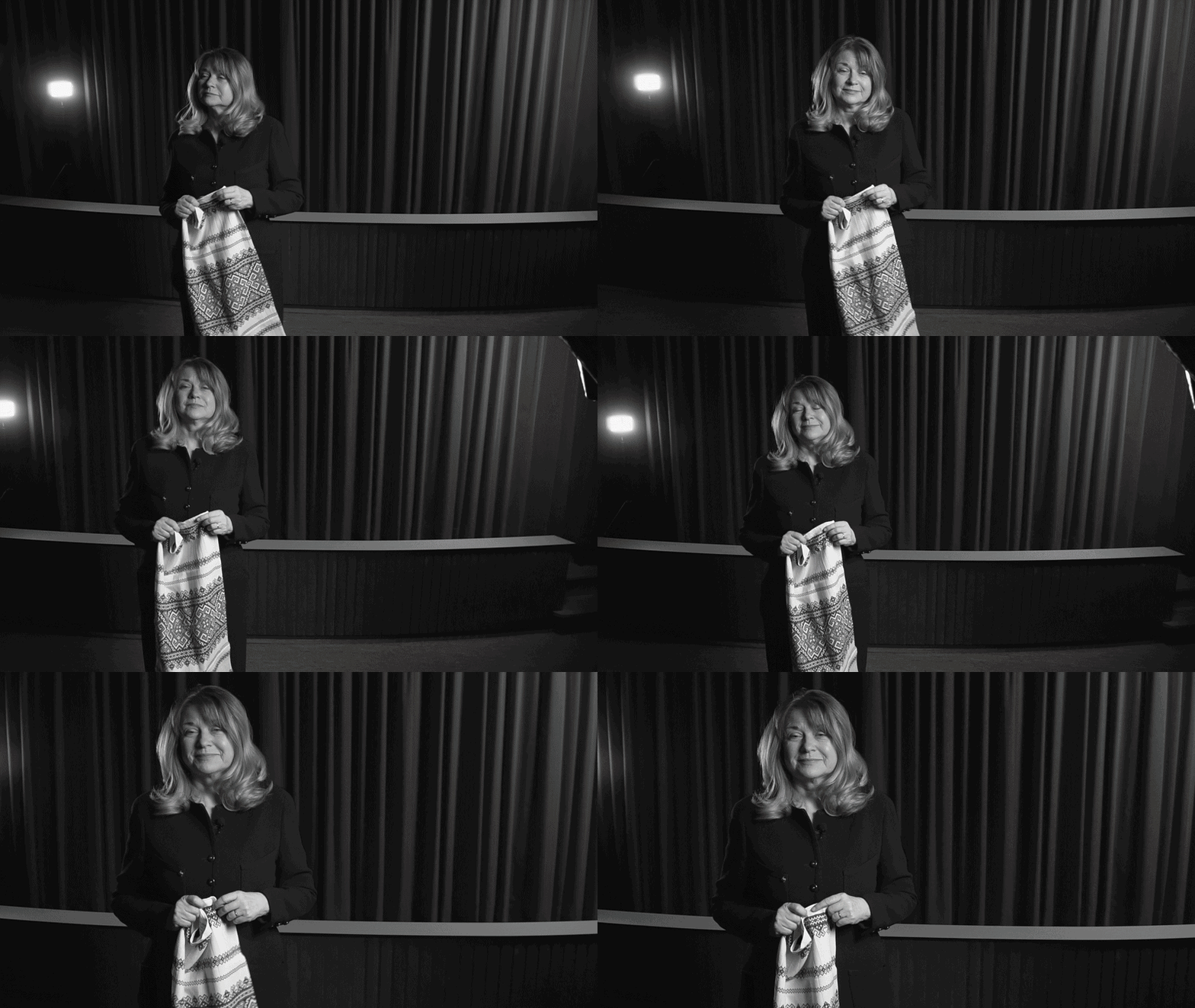
You’re referring to the Velvet Revolution in my country. Czechoslovakia was one of the last countries behind the Iron Curtain to wake up. At that time, I had just become a mother—my son was only a few months old—and the moment felt incredibly energising. I thought: Maybe he can have a different future. Maybe our family can reunite. Maybe he will grow up in a free system and make his own choices. I was very hopeful, even if older generations were more cautious.
I happened to be in a radio studio the day the first real news about the protests at Wenceslas Square was broadcast. Until then, we had heard only propaganda—“nothing is happening”—while the streets told a different story. You could see it with your own eyes that people were in the mood to change the system.
Once my aunt told me: “Imagine that you, as a mother, as an adult, can see yourself as a four‑year‑old and try to help that child. And then look at everyone the same way—and help them too
The radio building had been attacked in 1945, strange noises echoed, and I thought the tanks were coming. It was just a tram, but at one point militia surrounded the building, and my colleagues tried to hide me in a food lift so I could escape and spread the message if they were killed. In the end, nothing happened—we were lucky. Others were beaten or imprisoned, even if the revolution was “velvet.”
Let me stop on one more chapter, which I think is very important for the puzzle. Just after the revolution, we were able to finally reunite with our family in Britain and in the United States. My aunt from Britain, who couldn’t speak a word of Czech until that moment, saw my mother for the first time in almost 60 years. She had been sent away in 1948 after the communist coup and was never allowed to return.
As an eight-year-old, she was sentenced, in fact, to death by “betraying the country”. Hence her father never dared to call her back, and she had to stay away for decades. Watching the two sisters meet after this long time—suddenly children again—showed me how deeply early experiences shape us. She suffered the most, yet she was also the one to lead everyone through the pain and sadness and saw a positive side.
I believe the only way to come close is through compassion. Reason alone can’t grasp it. The only thing I can do is to go and to help. I don't know about the others, but this is my path
My aunt became a child psychologist and spent her life helping children who had lost parents or been separated from them. She knew she was also healing her own trauma. Once she told me: “Imagine that you, as a mother, as an adult, can see yourself as a four‑year‑old and try to help that child. And then look at everyone the same way—and help them too.”
She passed away about 10 years ago, but I would say she helped me bring this unconscious knowledge, which is within each of us, to the surface: You’re strong enough to help.
Sometimes people don’t even know why they try to help. Funny enough, when I came to Luxembourg and went through a variety of historical sources, I realized something about John the Blind—the Luxembourg ruler who became King of Bohemia. In his last battle at Crécy, he knew he was riding to his death.
At first it seems senseless. Why ride into battle when you cannot even see? But it made me ask: Do we truly understand what we think we see?
It’s the same with war, with 1968, with the Munich Agreement. You can read about these events in textbooks, but can you ever fully understand them from the inside? I believe the only way to come close is through compassion. Reason alone can’t grasp it. The only thing I can do is to go and to help. I don’t know about the others, but this is my path.
That moment of shared understanding is a small victory — the moment when we find a common language
Through our partnership with Luxembourg’s institutions and the people working in them, we try to find the right channels to build understanding. As a diplomat, communication is essential: choosing the right words, the right tools, and the right pathways so that people can understand one another, perhaps adjust their views, or realise that the other side has a point. That moment of shared understanding is a small victory — the moment when we find a common language.
And language, in the academic sense, is not the only tool. For some, understanding comes through a brilliant lecture—a moment of enlightenment. For others, it is music: something emotional that suddenly makes the news they have heard for months feel real. For others still, it is an image, a visual impact that opens what I call the “inner part of the onion,” allowing communication from heart to heart or mind to mind. These are all channels of unification, and that is what we are trying to create here.
Addressing threats is a realistic response to the world we live in
We’re trying to find the channels of unification. Journalists are trying to do it, politicians are trying to do it, diplomats are trying to do it. Well, but at the same time, we’ve got channels of disinformation. They try to do the very opposite. This is what our world is about. You’ve got different forces with different goals, and they are permanently colliding.
The idea of Eastern and Western Europe comes from the Cold War, from the Iron Curtain. Geographically, the Czech Republic lies further west than Austria, yet in terms of historical experience we are placed in the “East.” That period shaped us, and our current fears and perceptions of threat come from that experience. Some of us lived through it; younger generations know it through their parents’ stories or through films.
Addressing threats is a realistic response to the world we live in. What once seemed merely possible, we now know is not only possible — it is happening. So are we paranoid? I think that using that word just means that you don’t want to listen.
That professional conviction — that you can help, even a little — is another source of energy that fuels my support for Ukraine
What fuels your motivation?
Compassion is one reason. My personal experience is another. And my professional background matters as well, because being a diplomat means believing in the power of diplomacy. Just as a cardiologist must trust that their knowledge can help people — even knowing that every patient is mortal — a diplomat must trust that their work can help civilizations, even though civilizations, too, can disappear.
History shows us that cultures rise and fall, conflicts and genocides happen, and yet we still try to prevent them. That is why I often compare diplomats to doctors: from the outside it may look like we only write agreements and sign them, but in reality we work to keep societies alive.
You might ask: is humankind hopeless? Doctors ask themselves similar questions when patients ignore advice. And yet both professions continue, because even a small contribution matters. That professional conviction — that you can help, even a little — is another source of energy that fuels my support for Ukraine.
I think the ultimate goal for everyone is to find those inner sources of energy. The medieval philosopher Jan Amos Comenius called it the labyrinth of the world and the paradise of the heart. You should search within your own heart and find the right reasons, but that needs courage.