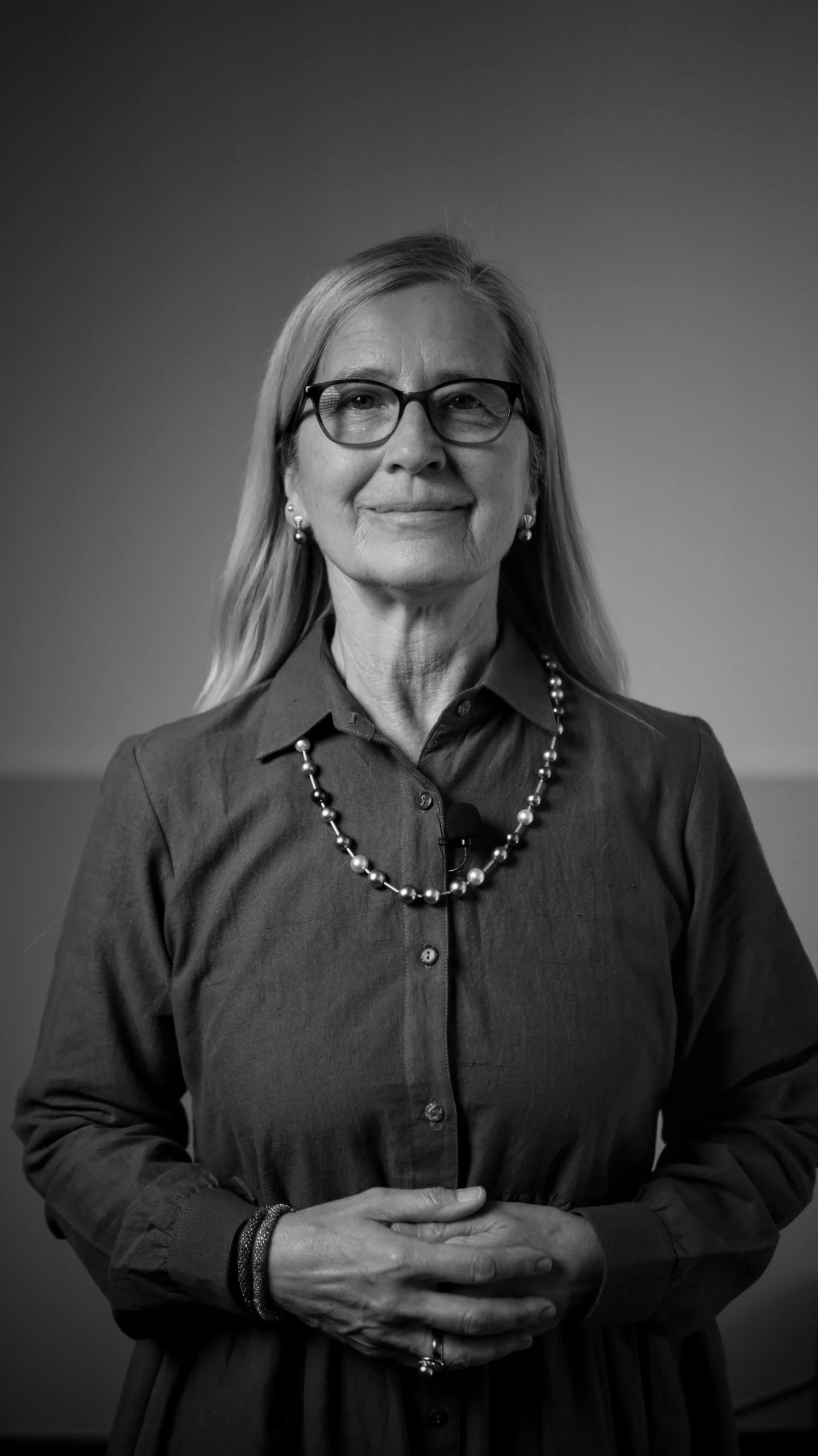
Brigitta Best
My name is Brigitta Best. I was born in Hamburg in 1959 and I have been living in Luxembourg since 1986. I often describe myself as an after-war child because I grew up in the shadow of what Germany had done during the Second World War, even though I was born after it.

Professionally, I am an intellectual property specialist, especially in trademarks. I started my own business in Luxembourg in 1995 and built it from zero to around fifty people in three different countries.
Could you introduce yourself and tell us a little about your background?
My name is Brigitta Best. I was born in Hamburg in 1959 and I have been living in Luxembourg since 1986. I often describe myself as an after-war child because I grew up in the shadow of what Germany had done during the Second World War, even though I was born after it.
Professionally, I am an intellectual property specialist, especially in trademarks. I started my own business in Luxembourg in 1995 and built it from zero to around fifty people in three different countries.
But art was always part of my life as well. My father was an opera singer. He could not really make a living from it, so he had another job too, but music was everywhere in our family. I think this is also one of the reasons why I support artists today and why I try to help them make a living from their art.
Next to my professional work, I do charity work for artists, but also for nature and social projects. The idea is often that we help artists become more independent and then, in return, artists help us with social projects. This can be projects for animals in Africa or the Seychelles, music projects for people with Asperger’s or autism, or the song we created with Ukrainian and Luxembourgish singers to show solidarity with Ukraine.
When we were children, my father always brought us to France. He learned French and he always spoke about how grateful he was to France and to French people because, even though he had been the enemy, they saved his life.
When I was eleven years old at high school, we were shown films of the liberation of the concentration camps. From that moment on, I was deeply ashamed to be German. I hated it. I said to myself that I would do everything I could in life to be a good person.
My mother was still a child during the war. My father was eighteen when he had to go to war, not because he wanted to, but because he was forced into it. He was in France, where he was shot five times, lost two fingers, and almost died. And he only survived because French civilians helped him. They found him badly wounded, and even though he was the enemy, they took him into their home because they saw that he was basically still just a boy. Doctors came. Later, when he was believed to be dying, a nurse refused to give up on him. She found a veterinary doctor who operated on him because the wounds in his back were completely infected. That saved his life.
That had a huge impact on me. On one hand, I grew up with the trauma of what Germans had done to the world, especially to Jewish people. On the other hand, I had a father who survived because other human beings chose humanity over hatred.
For me, human dignity is untouchable.I have tried to live my life according to that.
One of the most touching moments in my life was visiting Jerusalem and going to the Wailing Wall. When I touched it, I felt as if the guilt of a whole nation was on my shoulders.So today, wherever I can, I try to make up a tiny bit.
For me, there was no question. When this war started, none of us knew how long it would last. But for me, it was simply about being a human being and helping as much as I could.
That is also why we made the song. It was about solidarity, about being strong together, and about showing that we stand with Ukraine.I have to say, before the full-scale war I did not really know much about Ukraine. But when Bucha happened, it was so awful that I felt I had to do the small part that I could do.
I am not a politician. I am a private person. But the will to help was very strong.
And when Ukrainian refugees arrived here in Luxembourg, especially women with children, every single person had their own story. I just wanted to help, and I still want to help.
In my generation, everything that had happened during the Second World War was so horrible that we swore to ourselves: never again.
We felt that we had to do everything possible to be friends, to build peace, and to make sure this could never happen again.
When the European Union became a real political reality, I was deeply happy because I thought: this is the way to go.
In the 1990s, it felt as if Russia was opening up, the Soviet Union had collapsed, Germany was reunited, and countries were becoming free. It felt as if Europe had learned from the past.
And then Bucha happened.
It was such a shock because it showed that there are still people who do not respect human dignity.
I said to myself: whatever I can do, I have to do something. We cannot allow evil to win.
When I was young, I thought I would do anything I could to make the world a better place. Now I am in my sixties and I have to realize that evil exists in the world. But we have to make sure there is a balance.
Even if I am only one tiny piece of sand, if I can make a tiny difference, I want to do that. It gives my life purpose.
When the war against Ukraine started, I brought artists together and we said: we have to do something.
How did your initiative Voice Art & Social become involved in supporting Ukraine?
I had started my small nonprofit initiative, Voice Art & Social, right when the pandemic began. At that time, artists had no work because everything was closed. So the idea was to support artists and help them find ways to continue.
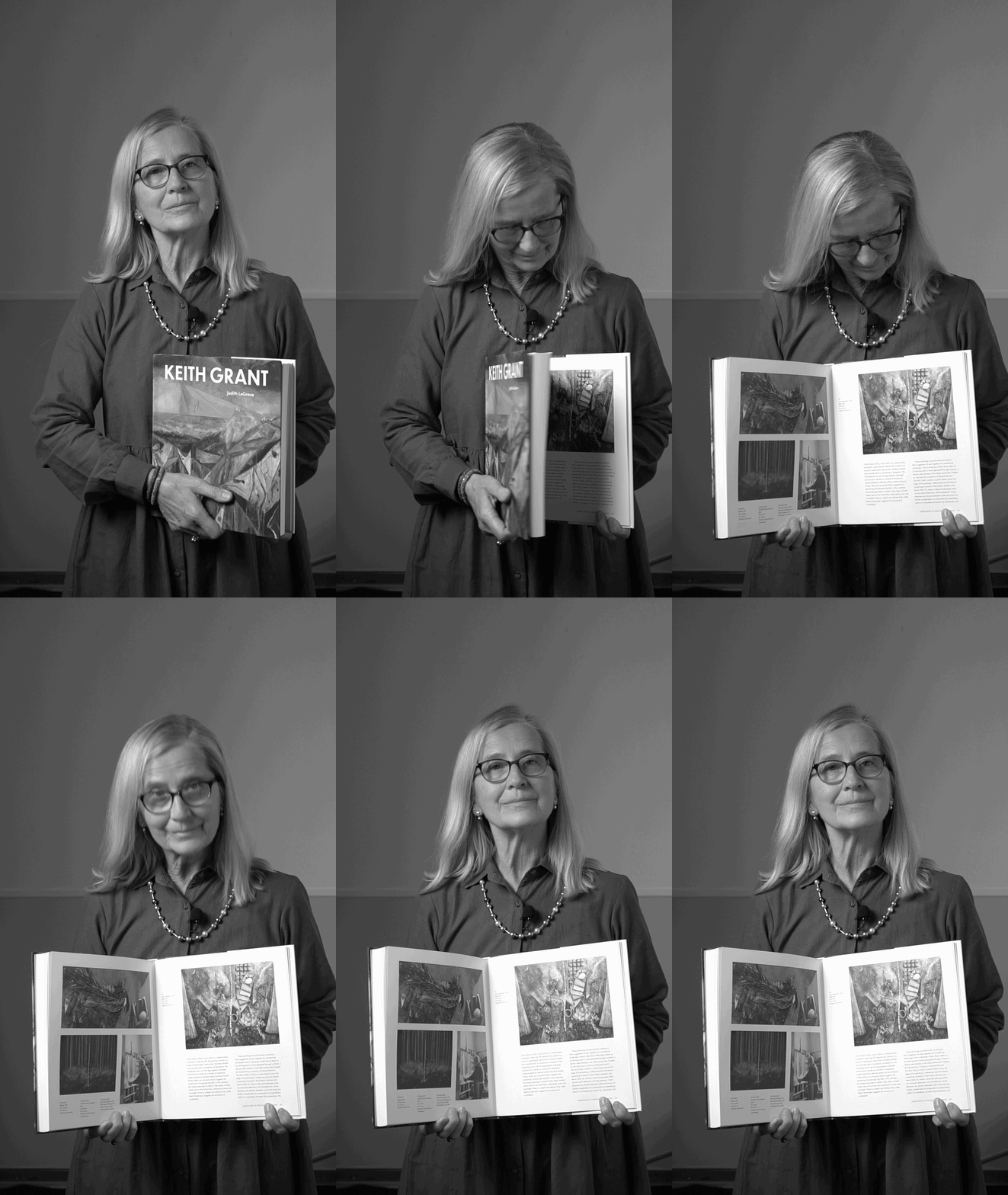
One of our artists, Keith Grant, who is ninety-five years old and still paints every day, immediately wanted to help. We had organized a nature art exhibition at the Biodiversum, but he also started creating paintings for Ukraine.
I then got in touch with LUkraine and met Inna Yaremenko and Nicholas Zharov. We organized a dinner, collected donations, and then came up with the idea of bringing Luxembourgish singers and Ukrainian refugee singers together to create a song and a music video.
The message was: we have to be strong together, and we have to show our solidarity.Keith Grant later donated four paintings, and through their sale we were able to buy four ambulances. We also donated around 25,000 euros to Tytanovi. That showed me something very important: art can do this. Art can help. Art can become concrete solidarity.
Many of the Ukrainian women I met have university degrees or had built independent lives and careers before the war. Some were successful businesswomen in Ukraine.
You work very closely with Ukrainian women and families in Luxembourg. What has this taught you?
The main reason I continue is the friendships and contacts I have built with Ukrainian people here in Luxembourg. They are amazing people. They are hardworking, courageous, and deeply determined.
When I see how Ukrainian women fight to protect their children, while also trying to integrate them here in Luxembourg so that they can have a childhood, I am very moved. My mother did not really have a childhood because of the war, so this matters deeply to me.
I know what it means to build something from scratch.
I started my own business in 1995 with no support. At the time, it was almost impossible to get money from banks or investors. I was alone with three children and had to create everything myself. It took me seven years before I really made money.
So when I see Ukrainian women who had their own businesses and who suddenly have to start again from zero, I want to help.
For example, one woman, Lilia Lekashva, had a patisserie and bakery near Kyiv. Because she did not have the kind of formal qualification required here, it took almost two years to get her authorized. But this year, in February, it finally happened. Now she can start her business again.
That is wonderful.
And I thought: how wonderful that this girl can become whatever she wants.That is what earlier generations of women helped prepare for the girls and children of today.
I grew up in a generation where girls did not have many rights or expectations placed on them. My teacher had to come to my parents’ home to convince them to allow me to go to high school because it was not considered normal. Later, when I finished high school and wanted to train as a banker at a large bank, the director asked me why I wanted to work, because I looked nice enough to get a husband.
That was the mentality.It was not normal for a girl or a young woman to want her own career.
But for whatever reason, I was always driven.Because I know how hard it is to build something from scratch, it feels completely natural for me to help others do the same.
At the same time, I truly believe in equality. I do not think it makes sense to give women more power than men. We have to be equal, on the same level. This morning, for example, I was with my granddaughter. She is fourteen months old and she loves machines. We went to a place where you can rent machines and there were huge trucks. She was fascinated.
I know women who still live with their children in very difficult conditions. One woman lives with her two boys in twelve square metres. The rooms, kitchens, and toilets are simply not good enough for building a normal life.
How do you see Luxembourg’s support for Ukrainians, and where are the challenges?
In the beginning, when we organized concerts and events, it was wonderful to see how many people in Luxembourg opened their homes and welcomed Ukrainians. The solidarity I witnessed was absolutely incredible.
Luxembourg has also done a lot politically and within the European Union to support Ukraine financially and in many other ways. That support is fantastic.But there is one area where I think we must do better: housing.I have tried very hard to find apartments for Ukrainian women with children, and it is almost impossible.
The problem is not always that there are no apartments at prices they could afford. Sometimes there are apartments for around 1,000 to 1,200 euros a month. The problem is that many owners simply do not want to rent to women with children.
We prepared beautiful files. We made sure the women could prove that they earned two or three times the rent, because I knew this would be expected. But again and again, the answer was no.Some women had to leave temporary accommodation very quickly and then ended up in tents in Kirchberg. I tried everything to find solutions, but it was practically impossible.
Of course, people are grateful that they are safe here and that they can stay in Luxembourg. But it is incredibly difficult to move from emergency accommodation into normal life: to work, to send children to school, to live with dignity. As a country, we must do better.
I have always been proud when people who worked with me became successful, sometimes even more successful than me. That is wonderful to see.
Helping people build a new existence has always been one of the greatest joys of my professional life.
With Ukraine, several moments stayed with me.Sending ambulances was very special. The song we created is also very close to my heart. Unfortunately, it is not played or used as much as I would wish, because it is a beautiful song and it brought joy to the Ukrainian singers who were here. It allowed Ukrainian and Luxembourgish singers, and also a Luxembourgish children’s choir, to come together and show that in art there are no wars and no borders.
Art connects everyone and everything.
Another very humbling moment was meeting the Tytanovi people at the LUkraine Gala. That was extremely touching. It was wonderful that through the sale of one of Keith Grant’s paintings, we were able to make a meaningful donation to them. I hope we will be able to do more.
At the end of the day, most of us want to be good. Most of us want goodness in the world.And when you experience that, it gives you something very precious. Not money, not material reward, but something that is good for your heart and for your soul.
Why do you continue doing charity work?
Sometimes people ask me why I do so much charity work, especially when there is no financial reward.
But that is not true. You do get something from it. When you do this kind of work, you witness how many good people there are in the world.So many everyday people do good things every single day. That feeds your heart and your soul.
Interviews & Directed by Victoria Boretska & Philippe Schockweiler
Camera, Editing: Igor Kryzhanovskij
© Lukraine.Asbl, Advocacy Coaliton.