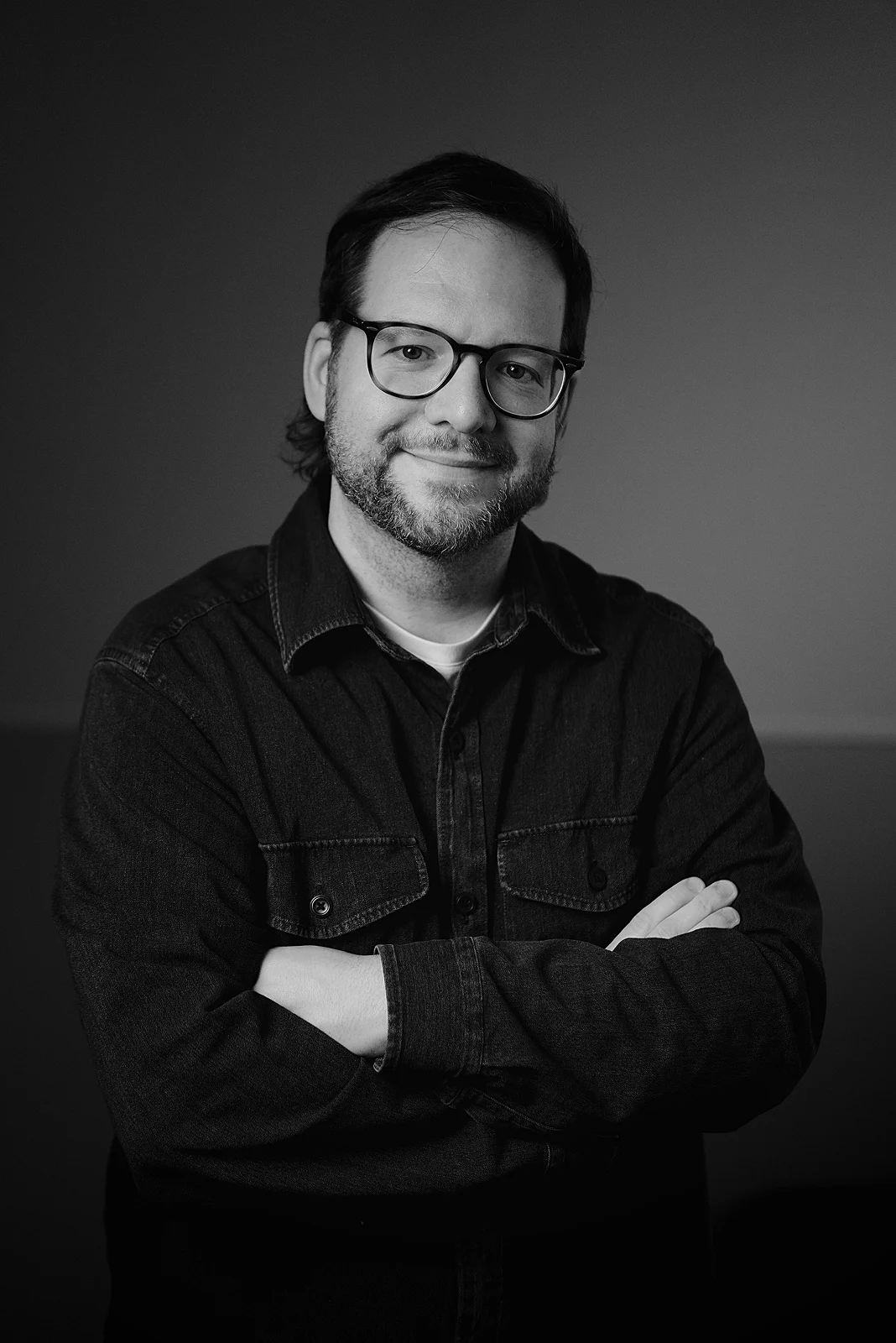
Philippe Schockweiler
Philippe Schockweiler is a Luxembourg-based journalist, documentary producer, author and volunteer who has been documenting Ukraine since 2005 and translating Ukrainian realities to Western audiences. He has focused his work on russian disinformation for many years. Through reporting, filmmaking, public debates, and cultural initiatives, he amplifies Ukrainian voices. Alongside his media work, he organizes humanitarian support and fundraising initiatives for Ukrainian soldiers and civilians, bridging journalism, cultural diplomacy, and grassroots solidarity with Ukraine.

I've rarely seen such a vibrant democracy as Ukraine. It is a country where people are arguing—all the time, passionately, about everything.
In early 2000s, Ukraine always gave me shelter
When did you hear about Ukraine for the first time?
I was born at the end of 1985, shortly before the Chornobyl disaster, and I became a child of that generation. Paranoia spread across Europe even faster than the nuclear cloud itself. During my whole childhood, my parents kept saying they might have been with us, children, right there in the rain* in April or May of 1986. Suddenly, this name — “Chornobyl” — it sticks in your mind.
There were documentaries for the fifth and tenth anniversaries of Chornobyl, and I definitely remember asking my father to help me tape those shows. So my awareness of this part of the world grew early. And I think, as a child, it also ignites something within you — researching and reading, going down the bunny hole to find more information.
If a full-scale invasion were to happen, my role would be clear. I would not sit back
How did Ukraine become a part of your personal story?
I was lucky enough to have worked as a human rights campaigner in Belarus in the early 2000s. For obvious reasons*, we often had to go to Ukraine. Ukraine as a country always gave me shelter. This was a very special feeling because in 2005-2006s Ukraine was a very safe place to be.
When you arrived in Kyiv, you had orange* flags rippling in the sky, and the next flag on the pole would not be a Ukrainian, but a European one. In the streets or in a bar, people would say to me, “We’re gonna become a member of the EU, and we’ll have a shared future together.”
Unfortunately, you also suddenly realised there was a downward spiral. Russia was trying to get an even stronger grip on the country. If you were there you could actually feel it. All your friends — journalists or people from NGOs — said it was getting more dangerous and the pro-russian parties were getting more financing.
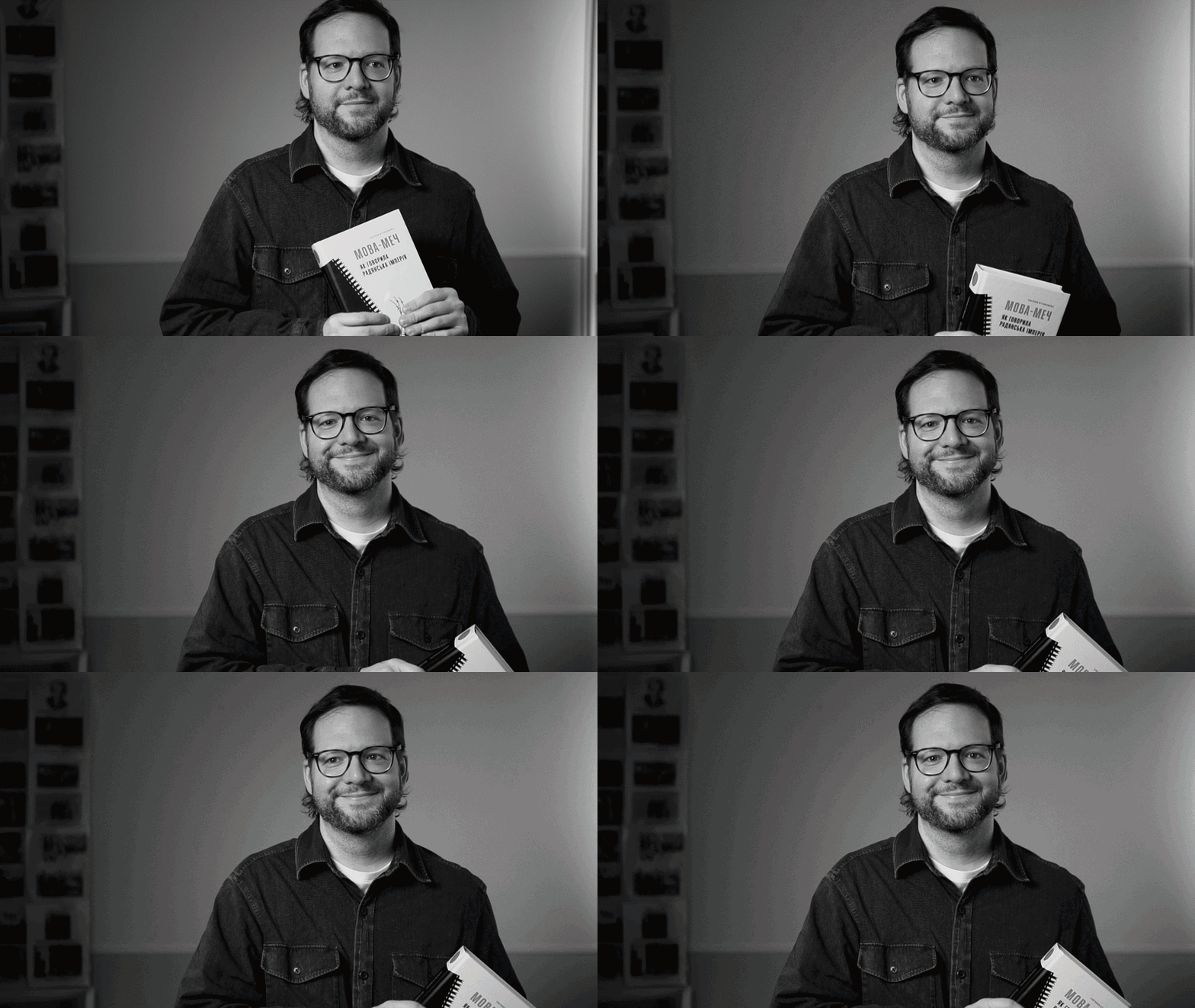
When I speak about the russian influence and russian propaganda, it’s because I also felt it firsthand, even before Maidan*, and before Yanukovych* came to power. What happened after Yanukovych — with the Revolution of Dignity on Maidan, the illegal annexation of Crimea and the beginning of russia’s war in the East* in 2014 — already showed me this was not going to end well.
For me, it was clear that a bigger catastrophe was brewing and that russia would not stop at this point. And if a full-scale invasion were to happen, my role would be clear too. I would not sit back, I would not sit idle; I would definitely — and as fast as possible — try to go to Ukraine and connect with all the people I know there: the journalists, the NGOs, and all the friends who would sign up to do the right thing.
Fast forward to now: it’s been over 20 trips since the full-scale invasion, one documentary co-produced, dozens of articles written, tons of humanitarian aid delivered. The rest is history, so to say.
further catastrophe could have been prevented if we had had stronger responses
European reaction: Have we learnt our lessons?
It was so striking for me back then how weak the European and US response was. European and Western leaders at the time were more concerned about russian oil and cheap gas. If you talk to European diplomats off the record, they will tell you this was exactly the reason why the actors were so reluctant.
So if you realise all that, and you’ve seen it firsthand, you come to the conclusion that a further catastrophe could have been prevented if we had had stronger responses earlier — to what had happened with the illegal annexation of Crimea, the war in eastern Ukraine in 2014 or the downing of the MH17 civilian airliner.
I am personally convinced that a stronger response vis‑à‑vis russia would have helped Europe and the world live in a safer environment today.
There never was a peaceful Soviet Union. It was always linked to occupation
I think one of the major challenges today in European integration is that we failed to acknowledge the Eastern European realities — and where the independent Central and Eastern European countries come from.
When we read history books, also in our schools in Luxembourg, the end of the Soviet Union seems rather peaceful. We fail to see that over decades the Soviet Union has brought so much violence to what they called their “brotherly nations”. People who broke away from the Soviet Union in the early 90s or in the end of the 80s often did so with a lot of blood.
For us, the Second World War ended, but there (in Eastern Europe) there was occupation. There never was a peaceful Soviet Union. It was always linked to occupation. We failed to acknowledge that even these symbols are painful for people who lived under them.
The new West starts on the Eastern frontline in Ukraine and it stops in Europe
I realised that some people also just don’t want to hear it — not because they don’t want to deal with it, but because there is an intellectual incapacity to realise that russia is an aggressor. They have been so instrumentalised by ideology and by Soviet romanticism, and I always ask: what is so romantic about that?
It is still so convenient to think in blocks and we see this in many other wars in the world. It’s the block thinking and the spheres of influence which imprints this in people’s minds, and I think especially with what’s happening now in the United States. That is the old West.
If we teach more disinformation resilience, if we dare to speak to people in easy terms while nevertheless going into depth, then we can make a difference. We always fear that people will not understand us. But no — we should talk and keep informing, always go the extra mile, never stop reporting. Otherwise I wouldn’t be doing what I have been doing for the past 20 years. And I will definitely continue to do it for another 20.
Whenever somebody in Western Europe hears “Ukraine,” they think — trouble. And that’s not because of Ukraine
What is the main challenge in communicating Ukrainian realities abroad?
I think the biggest challenge is not doing it. Basically, if you are not doing it, you are failing already. Somebody else will occupy that information space. When it comes to information space, first one’s the winner.
This is what made russian propaganda about Ukraine so successful before. They managed to manufacture a chain of association: whenever somebody in Western Europe hears “Ukraine,” they think — trouble. And that’s not because of Ukraine. It’s because this image has been instilled and distilled by russia into the minds, to the point where people started accepting it as a fact.
So, first and foremost, you need to be the first one, and you need to do it. If you don’t do it, somebody else will.
The other challenge is to counter the disinformation that is already there — it is always harder than putting out some very well-produced, verified information. Even if we produce Oscar-winning documentaries like we saw two years ago, great articles, photo series, exhibitions, if we talk about the Ukrainian realities, a lot of the minds are already occupied by russian disinformation.
What we need to create is really a sort of propaganda/disinformation resilience — in schools, in our society, in politics. Because one thing we need to explain over and over again is that these lies and this disinformation are the theoretical basis for the invasion of Ukraine.
I don't need to give a microphone to the aggressor
When trying to reduce the space or counter russian propaganda, some irritatingly say you are infringing upon the basic democratic values of freedom of speech. And that’s quite interesting, because I actually think the opposite is the case.
Russia still has too many channels to reach European hearts and minds — influencing elections, social media, our political debates, financing parties on the fringes of legality on the left and right. We are still not really doing everything, as Western societies, to stop that. So here I see a huge discrepancy in our thinking.
There is so much russian propaganda. People in Western Europe were asking me why I was not interviewing the russian side, and I said, “Well, because I’m sitting in a bomb shelter and I’m being bombed, so there is no russian side here”. I don’t need to give a microphone to the aggressor.
Freedom of speech is the right to critically engage with people on a respectful level. It is not there to sanitize war crimes and genocide
Yes, freedom of speech is the absolute human right. It’s the one that’s most crucial for us and that we as journalists care about the most. But we also know that your freedom of speech cannot infringe on somebody else’s — or, even worse, on somebody’s freedom to be and to have a dignified life.
If by freedom of speech you mean repeating vile russian propaganda, which calls for the killing of innocent civilians or tries to downplay what russia has been doing in Ukraine, then that’s not it. Freedom of speech is the right to critically engage with people on a respectful level. It is not there to sanitize war crimes and genocide.
So in the end, the people who are criticizing us so harshly on this: you are criticizing in a democracy and it’s wonderful. It’s your right. And you know what? If you’re constructive in criticizing somebody in a democracy, you might even be invited to the table. It’s how our system works.
It’s about having your voice out there — and being able to do so. And I’ve worked in dictatorships in the world. I know how it is when people are taken to prison for precisely something they said.
I've rarely seen such a vibrant democracy as Ukraine. It is a country where people are arguing—all the time, passionately, about everything
Why does Ukraine matter?
Ukraine matters — and not only for Europe. It matters to the world. I’ve rarely seen such a vibrant democracy as Ukraine. It is a country where people are arguing—all the time, passionately, about everything. That is such a beautiful little reminder of what the smallest incubator of a democracy is: dissent. It is talking to each other, it is arguing and arguing. And that’s what’s so wonderful about Ukraine.
Ukraine has managed, over the past 30 years, to put this on a national level. They’ve created so much for the country, and they created a vibrant economy, a democracy that became so powerful it became a threat for their neighbour. Apparently, if one of the biggest dictators in the world cannot stand one thing, it is a free country at his border. And so, if you think about why Ukraine matters, it is because of this reason.
And of course, it is also the courage, the resistance, the resilience. It is the fact that Ukrainians don’t give up — which is a value, especially if you fight for your freedom, that should concern us all.
Footnotes:
\ rain* — Refers to the radioactive fallout carried by rain after the Chornobyl nuclear disaster in April 1986. Many families across Europe feared exposure because contaminated rain clouds moved unpredictably across the continent.
\ obvious reasons* — Indicates the political repression and authoritarian climate in Belarus in the early 2000s
\ orange* — Refers to the Orange Revolution (2004–2005)
\ Maidan* — Short for Maidan Nezalezhnosti (Independence Square) in Kyiv; also used to refer to the Euromaidan protests of 2013–2014, which demanded closer ties with Europe and opposed government corruption.
\ Yanukovych* — Viktor Yanukovych, the Ukrainian president (2010–2014) whose refusal to sign the EU Association Agreement triggered the Maidan Revolution of Dignity and who later fled to russia.
\ East* — Refers to the Donbas region in eastern Ukraine, where russia initiated the war in 2014.