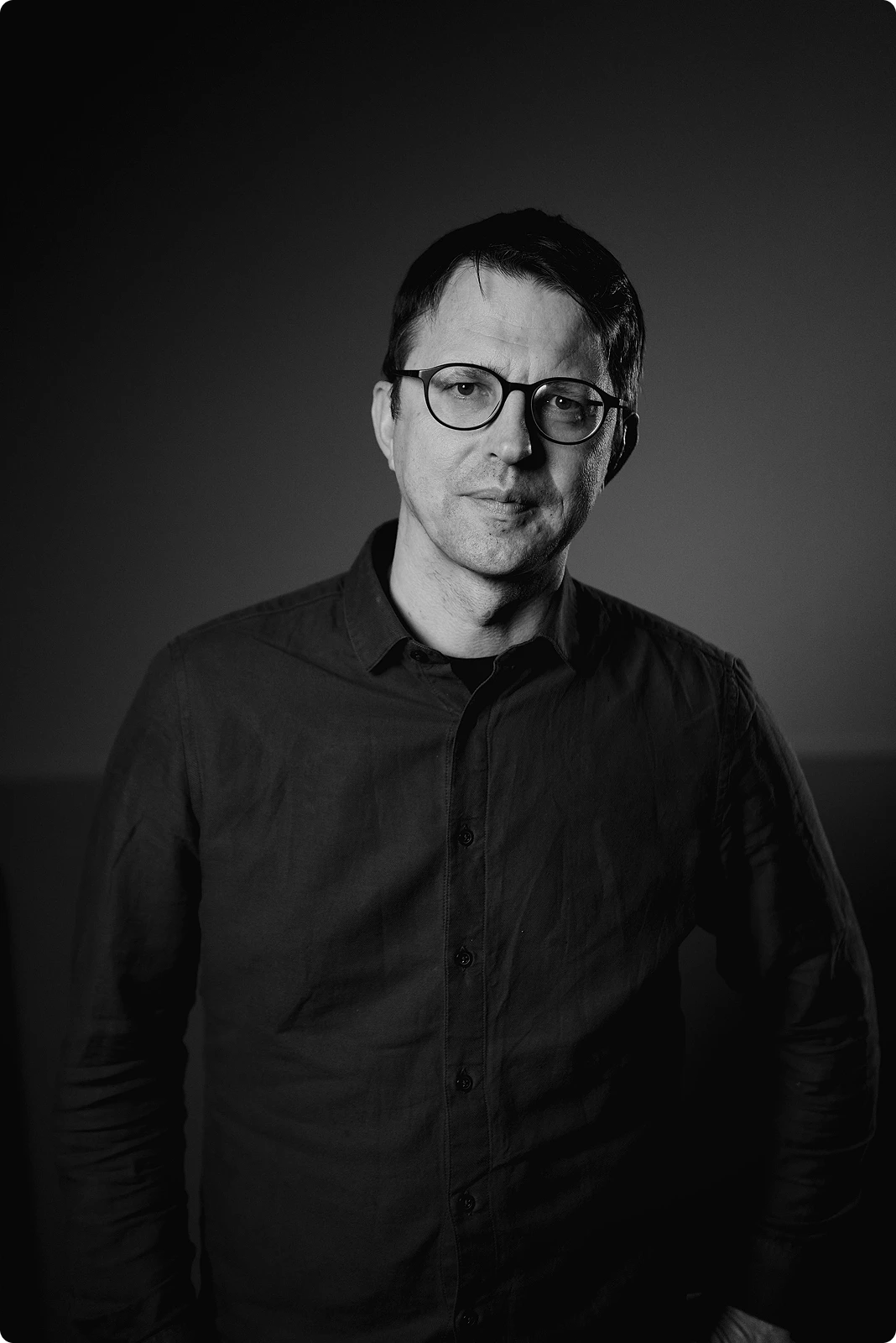
Radek Lipka
Radek Lipka is a Luxembourg‑based cultural organizer and cinephile who co‑founded the Central and Eastern European Film Festival CinEast. Shaped by Poland’s history and committed to Ukraine since 2014, he combines film programming with humanitarian work and countless volunteer projects.

Do everything so that people do not stay indifferent. It’s not only about morals or doing the right thing—it's elementary justice, and it's in our own interest. If you don't do it for Ukrainians, do it for yourself
It all happened naturally, bottom‑up, without a master plan
I didn’t study film—I studied philosophy and human sciences in Paris, and a bit in Germany. But I was always a cinephile. I lived in the Quartier Latin, surrounded by small art‑house cinemas, and that’s where my film culture comes from.
When I came to Luxembourg, I worked as a translator at the European Commission. My friends and I noticed that although Luxembourg had many cinemas, films from my country—Poland—and more broadly from Central and Eastern Europe were almost never shown. So we organized what we thought would be a one‑off event: the Week of Polish Film in 2006. We expected 200 or 300 people; 800 came. It was such a success that we felt we had to continue.
Of course, we didn’t want to repeat Polish films every year, so we invited the Czechs, Slovaks, Hungarians… and little by little, a festival was born. That was 18 years ago. It all happened naturally, bottom‑up, without a master plan. Some people were just giving you their ideas, their energy, and bringing you in directions you didn’t plan before. We added things step by step—concerts, exhibitions, debates. That’s how the festival began in 2008.
I think what shaped me most is the general sensitivity shared across Central and Eastern Europe, the Baltics, also Finland, of course, for historical reasons. Our history teaches us vigilance from childhood
My journey wasn’t typical for someone born in Poland in the late 70s. I spent five years of my childhood in Algeria, where my parents worked. But I do remember 1981 and the years that followed. Poland didn’t have Soviet tanks on the streets like Budapest in 1956* or Prague in 1968*, but it was close. We had Polish tanks instead, under Soviet pressure.
Later, through family and friends—some of whom were in Solidarność*—I learned more. People were imprisoned, some died. It was serious, even if by the mid‑80s the atmosphere was already influenced by Glasnost and Perestroika*.
I think what shaped me most is the general sensitivity shared across Central and Eastern Europe, the Baltics, also Finland, of course, for historical reasons*. Our history teaches us vigilance from childhood. Poland disappeared from the map for 130 years, one piece was taken by Russia, other sides were taken by Prussia and Austria-Hungary. We know what imperialism looks like. And already before Crimea, many in Poland were warning that Russia’s imperial ambitions were returning. No one imagined 2022, but the signs were there.
So I was shaped on the one hand by this Polish history and on the other by the European past. How could it go completely unattended, saying, “Okay, let’s give them Crimea so we can forget about it”? The lesson is clear: you must never rely solely on negotiations or attempts at appeasement. With dictators, it leads nowhere. It is entirely the wrong approach.
The turning point came in 2013–2014, during the Revolution of Dignity*. Before then, we hadn’t shown Ukrainian films. In 2014 we invited Sergey Loznitsa—already well‑known at the time, though now controversial for some of his views—to chair the jury and present his film Maidan (2014). It was a powerful document of the revolution. Around the same period, LUkraine asbl was just beginning, and that’s when we started working together.
Then came Crimea, Donbas… and from that moment we began showing Ukrainian films regularly, organising Ukraine‑related screenings, debates and concerts, and building friendships with Ukrainians living here.
Another important moment for me was my first—and so far only—trip to Ukraine in 2016. I went to Lviv, where my grandmother had lived before and during the war. I also visited Lychakivsky Cemetery* to see the Polish graves, and there I witnessed a military funeral for Ukrainian soldiers killed in Donbas.
Involvement was no longer optional. It became a duty—an elementary matter of human decency
Seeing 30 or 40 soldiers burying their comrades… it was an initiatic moment. The war was suddenly right in front of me. After Crimea for me it became obvious that it wasn’t a small “regional conflict.” It was something we had to talk about. We had to show solidarity, to give visibility to people who are there, who are shooting films there and risking their lives. That came naturally with this visit to Ukraine in 2016.
And then, of course, the full‑scale invasion in 2022. After that, involvement was no longer optional. It became a duty—an elementary matter of human decency. I also believe there is no small contribution. It’s great if you can give 50 euros or send blankets to Ukraine, or if you can just go and see the film—all this is important. People often think: If I cannot help a lot, then I don’t help at all. But it’s not true. Every small grain contributes to the collective resistance.
People often think: If I cannot help a lot, then I don't help at all. But it’s not true. Every small grain contributes to the collective resistance
It started as a simple need of the heart. Our first charity screening took place in early March 2022, just days after the full‑scale invasion. We showed The Earth Is Blue as an Orange (2020) by Iryna Tsilyk, a documentary film about life in Donbas during the war. But almost immediately, everyone in our association was asking what more we could do. People in Ukraine needed ambulances, medical supplies, most basic necessities.
The response was huge—almost 5,000 euros from one screening. Before that, our charity efforts were small: 2,000–4,000 euros per year. Suddenly we were raising 10,000, 12,000, 16,000 euros. Together with LUkraine asbl, we have already sent four second‑hand ambulances to Ukraine, and we continue. It was never even a question.
I truly believe in the extraordinary capacity for human solidarity. When you open even a small project, people will follow and contribute. Sometimes they just need a concrete way to help. When they see that their donation sends an ambulance to eastern Ukraine or keeps someone warm during a −20°C winter in Kyiv, they respond.
In February this year, during the extreme cold, we joined the Czech project SOS Kyiv. In ten days, we raised over 3,000 euros. It shows that people are not indifferent—you just need the right words and a clear purpose to reach their hearts.
the most important commandment is the 11th commandment, and it says, you should not be indifferent. And I really believe it
Cinema is different from news. After a while, after one year of war—let alone four—people become resistant to headlines. They have the impression of having already heard everything—about the attacks, the drones, the infrastructure.
Film gives you the power to show human stories and develop people’s empathy. You can resist the headlines, but it’s difficult to resist the real people who are telling you about their first-hand experiences. And not only you cannot ignore them—it stays with you longer.
I would say this is really the privilege and this is why since 2022, even before, we really wanted to create Q&As and debates. It became a tradition that at least one film is followed by a longer discussion sometimes with prominent political figures.
You need some kind of free mind in order to act. If you start to think every single day about all the massacres that were committed, you lose the power of action
Documentaries are especially powerful. Films such as 20 Days in Mariupol (2023) or 2000 Meters to Andriivka (2025) by Mstyslav Chernov bring you closer to the front line than anything else. The second is also in large part filmed by the soldiers themselves. So it’s hard to say that there is this side of propaganda and that other side. We try to bring films with indisputable and striking facts.
It’s also not about watching films like you would watch any other films. It’s not only about getting the information, but also about acting upon it and not staying indifferent, which is why we developed our charity project.
There is this great Holocaust survivor, Marian Turski, who was featured in a Luxembourgish-Polish co-production film (The Living WItnesses) and unfortunately passed away recently. At the 75th anniversary of the liberation of Auschwitz he said that perhaps the most important commandment is the 11th commandment “you should not be indifferent”. And I really believe it.
If you see what you see on the screen, if you see all the documentaries and all the materials about Bucha, Izium, Mariupol, you cannot be indifferent. And you can also not pretend that this doesn’t happen. Once you’ve seen it, you cannot unsee it.
If I had to name one core message: do everything so that people do not stay indifferent. It’s not only about morals or doing the right thing. If you don't do it because of Ukrainians, do it for your own interests
We all have our defense mechanisms, it’s also natural. I’m not criticizing anyone. You need some kind of free mind in order to act. If you start to think every single day about all the massacres that were committed, you lose the power of action.
We also think that we need to bring Ukrainians closer to people here. There are several thousands of Ukrainian citizens here in Luxembourg, but, we don’t necessarily know each other well enough. With the festival, I happened to meet a lot of Ukrainians. We think it’s important to show also feature films, historical films, even comedies, tragicomedies—so to bring closer to other residents their rich culture, identity, and history and foster mutual understanding.
If I had to name one core message: do everything so that people do not stay indifferent. It’s not only about morals or doing the right thing—it’s just justice, elementary justice, and it’s in our interest. It’s our first interest. If aggression is not stopped in Ukraine, it will spread to other countries. History shows this clearly. If you don’t do it because of Ukrainians, do it for your own interests. I think that would be the message.
The war is not something which affects only its direct victims. We see what’s happening now with the war in Iran. All the Middle East is affected and probably very deeply. And if there would be strikes in any EU state, the repercussions could be even larger.
festivals must use every tool they have to support truth, clarity, and solidarity
It’s difficult to speak for all festivals, because the debate is complex. In 2022 many asked whether Russian films should be excluded entirely, or only those with state support, or even older titles. I can only explain our own position.
We never programmed Russian films in the first place. The festival grew organically—first EU countries, then Ukraine in 2014, then Georgia. Russia was never part of this structure. And after Maidan, Crimea, and Donbas, it was out of question of course to consider adding Russian films anyway, since productions are backed by the state or by oligarchs aligned with it.
For us, the decisive question when considering war-related films is quite simple: does the film serve the Ukrainian cause and our common European fight?
We had similar reflections with the Ukrainian film Intercepted (2024), which uses recorded phone calls of Russian soldiers. These voices are Russian, but the film is Ukrainian and extremely important. It shows how the regime shapes minds from within.
So our approach is case by case. If a film is independent, if it exposes the regime rather than serving it, and if it ultimately strengthens understanding of Ukraine’s struggle, then we consider it. It is not a compromise. It is a strategic choice.
A particular case was the recent awarded production Mr. Nobody Against Putin (2025), and in this case it was clearly a compromise for us. There was one scene that troubled us particularly: coffins of Russian soldiers, presented almost without context, as if Russian and Ukrainian losses were equal. They are not. That moment clearly lacked perspective. But overall, after long discussions we arrived to the conclusion that there were still more arguments to show it, with the right explanation, because it had the potential to reach more and new audiences.
In the end, festivals must use every tool they have to support truth, clarity, and solidarity, keeping in mind the larger goals. And sometimes that means showing a film that opens a door for people who would not walk through it otherwise, but of course we understand that different choices can be made by other people for other audiences.
Footnotes:
/*Budapest 1956 — The Hungarian Revolution of 1956 was a nationwide uprising against Soviet control. It was brutally suppressed by the Red Army, resulting in thousands of deaths and mass repression.
/*Prague 1968 — The Prague Spring was a period of political liberalization in Czechoslovakia. It ended when Warsaw Pact troops, led by the USSR, invaded the country to halt reforms.
/*Solidarność (Solidarity) — A Polish trade union and social movement founded in 1980. It became the first independent labor union in the Soviet bloc and played a central role in ending communist rule in Poland.
/*Glasnost and Perestroika — Reform policies introduced by Soviet leader Mikhail Gorbachev in the mid‑1980s. Glasnost promoted openness and freedom of information; Perestroika aimed at restructuring the Soviet political and economic system.
/*Historical reasons (Central and Eastern Europe, Baltics, Finland) — These regions share a long history of Russian and Soviet imperial domination, including occupations, annexations, and political repression, shaping a collective sensitivity to authoritarian expansion.
/*Revolution of Dignity (Euromaidan) — A wave of protests in Ukraine from November 2013 to February 2014, sparked by the government’s refusal to sign an EU Association Agreement. It led to the ousting of President Yanukovych and marked a decisive turn toward Europe.