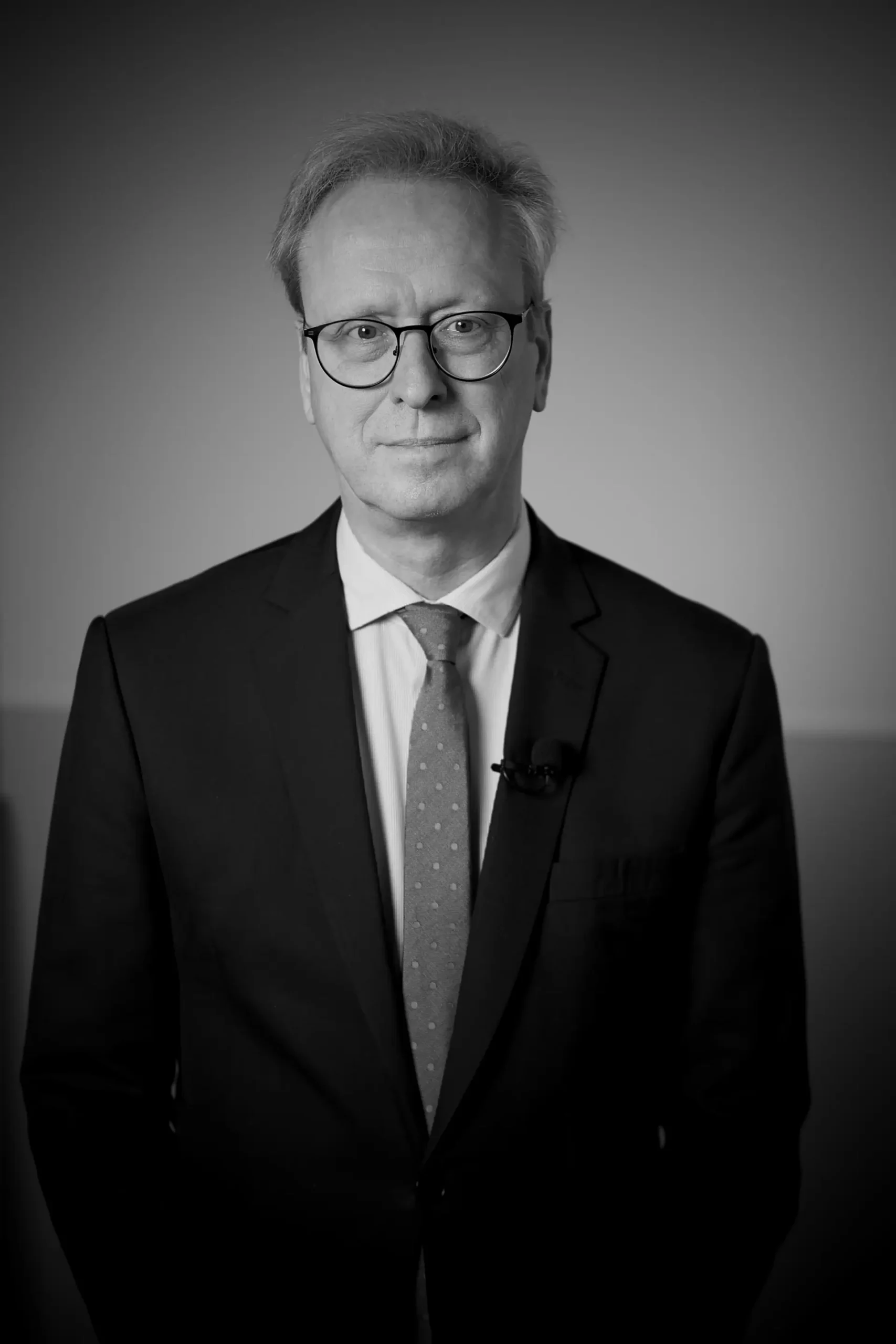
Charles Delogne
I studied political science and also received a financial education. I grew up in a family where intellectual curiosity was very present. My father was a university professor and from a very young age I already had an interest in politics and international relations. I first began my career at the Belgian Ministry of Finance as a corporate tax editor, but at the same time I took the diplomatic exam and was successful. So I entered the Belgian Foreign Ministry in 1993, just before the Belgian Presidency of the European Union.

“The First Thing a Diplomat Must Do Is Love People.”
Amazingly, the very first region I visited was Sumy. And Sumy later became the place where my two adopted children were born.
It was quite a remarkable period because it was during that Presidency that the Maastricht Treaty entered into force and modernised the European Union in a profound way. My diplomatic traineeship took place in Rome and I often joke that it felt like six months of holidays because once you left the embassy, every street and every stone in that city had a story to tell.
And then, in 1996, I arrived in Kyiv with my wife and we stayed there for three years. Ukraine at that time had a very different face from today. The country was going through difficult economic reforms and was still discovering the practice of pluralism and democratic political culture after the collapse of the Soviet Union. But what impressed me immediately was the atmosphere of tolerance and dialogue that already existed inside Ukrainian political life.Ukraine had coalition governments. Politicians had to speak with each other, negotiate with each other, and develop a culture of compromise.
I think this is extremely important to remember today.At the same time, I became a member of the Trade Club of Ukraine, which allowed us to travel extensively throughout the country. We visited almost all of the twenty-seven regions.
Kyiv was already a fascinating city where you could walk for hours. Many buildings were still in difficult condition after the Soviet period, but their beauty was already visible beneath that reality.
Absolutely.
At the time, not many diplomats actively wanted to be posted to Ukraine. But from the very beginning we discovered a country filled with warmth, intelligence, humour, and extraordinary hospitality, despite extremely limited material means. We were genuinely very happy there.
At first, relatives and friends from Belgium and France were hesitant to visit us because Ukraine still seemed very far away and unfamiliar to many Western Europeans in the 1990s.
But once they came, they were amazed.
Not only by Kyiv itself, but by the people, the atmosphere, the culture, and the regions we showed them across the country. When I eventually left Ukraine in 1999, I left with a very strong feeling of confidence in the country’s future.
The people were highly educated, extremely hardworking, and remarkably tolerant.I felt already at that time that Ukraine had all the qualities necessary for a European future.
And what is important to remember is that Ukrainians themselves consistently expressed this aspiration democratically.
Already in the elections of the late 1990s, Ukrainian voters mobilised strongly and supported candidates promising Euro-Atlantic integration. And later political leaders continued making those same promises, which also created expectations among the Ukrainian population.
This is something Europe must keep in mind today.

Why does Ukraine matter for Europe and for the European project itself?
First of all, Ukraine is an independent state whose sovereignty was confirmed overwhelmingly through a democratic referendum in 1991, including in eastern regions and Crimea.
So when today we hear narratives denying Ukrainian identity or Ukrainian statehood, these positions are not only historically false, they are deeply cynical.
Ukraine matters because its independence is directly linked to the idea of a peaceful Europe.
As long as Ukraine remains independent, Europe does not again face the reality of an uncontested imperial superpower threatening the continent from the East.
This strategic understanding already existed in the 1980s and 1990s and remains completely valid today.
Ukraine is therefore not only defending itself.
Ukraine is also protecting the long-term security architecture of Europe.
We must continue repeating very clearly that if Ukraine were to lose this war, Europe itself would face severe consequences for its own security. Ukraine’s security is also our security.
I think we first need to explain how much Ukraine has evolved during the last thirty years.
Ukraine developed genuine political pluralism and democratic practice inside a sovereign state. This matters enormously when we speak about European integration and compatibility with European democratic standards.
The second point is geographical reality.
People sometimes psychologically perceive Ukraine as something distant, but the distances themselves have not changed. Brussels to Kyiv is around twenty-two hours by car. Ukraine is geographically extremely close to us.And therefore the tragedy taking place there is not distant from Europe at all.
They answered very simply: “Charles, we have been working for thirty years. So it is normal that there are results.” That sentence stayed with me.
I returned in 2001 for the adoption of our second child and then again in 2021, twenty years later. We decided to travel to Ukraine by car because I wanted to physically observe the country’s transformation. And the difference was extraordinary.
The economic development was immediately visible. Infrastructure had improved enormously. Kyiv had become a vibrant European capital filled with restaurants, cultural life, businesses, shops, and social spaces that simply did not exist in the 1990s.
But the transformation was not only economic. What struck me most was the psychological transformation of society itself. The people I rediscovered in 2021 were confident.
Confident in themselves, confident in their country, and no longer afraid. Many of the old structures inherited from Soviet authoritarianism had gradually disappeared. People spoke freely. Society had become genuinely liberal. And I still remember very clearly one sentence somebody told me when I enthusiastically commented on Ukraine’s progress.
I recently arrived in Luxembourg after serving in Pakistan and many people told me this must have been an enormous change. But we were very happy in Pakistan too.
Every country is interesting if you genuinely try to understand it. Every society has a story to tell, and diplomats are not there to lecture people. We are invited guests: Our role is first to listen, to understand how a society functions, how people think, what their concerns are, and then to maintain and strengthen relationships between countries.If you approach diplomacy in that spirit, then every country becomes fascinating.
Listening to you, one senses a very humanistic philosophy behind diplomacy?
I think a very experienced ambassador once explained this better than I ever could. He told young diplomats that were in training: “The first thing a diplomat must do is love people.”
If you are incapable of that, you will never be happy abroad and you will never truly serve your country either. My own interpretation of this idea is perhaps simple.To love people means helping them grow, helping them improve, helping tomorrow become slightly better than today.A diplomat can contribute modestly to this.
The first lesson is very simple. People hate war. When you witness countries destroyed by violence, when you see psychological trauma, destruction, displacement, and suffering, you realise very quickly that war is among the worst things human beings can experience.
This is why diplomacy matters so much. Preventing wars and stopping wars remains one of the essential responsibilities of diplomacy. The second observation is that across the world, societies organise solidarity in remarkably similar ways.
In many countries governments have ambitions they simply cannot fully implement due to lack of resources. And then civil societies step in.
People organise themselves.
Families organise solidarity. Communities create systems of support. This exists everywhere.What changes from country to country are mostly the structures around it.
Sometimes, when we come from wealthy Western societies, we risk judging other societies too quickly because they appear more archaic to us. But we forget that our own societies functioned very similarly only a few generations ago. That is why humility is very important.